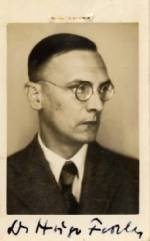
When Hugo Fischer died on May 11th 1975 at the age of 76 in the town of Ohlstadt in Upper Bavaria, nobody was supposed to recognize this news, at least officially. Fischer was a forgotten thinker. Towards the middle of the 1950s, he returned from India, from Varanasi, and lost all contact with the academic world of West Germany. Only a few tenuous threads vaguely linked him to the University of Munich, so he continued to lead the life he had always lead: an underground existence, the existence of a savant turning inwards into his private sphere. Yet, after his death, two voices raised themselves to recall the importance of the deceased, to judiciously draw up the critical reading of his work. The first voice was Armin Mohler: in the columns of the daily Die Welt, he declared that Fischer “had been one of the principal intellectual pioneers of the German mind in the decisive years before and after 1930.” Fischer, Mohler added, was somewhat of a “midwife of intelligence,” in such an eminent manner that a legend was peddled on this subject: that he created Ernst Jünger’s “nationalism of the front-line soldiers” (soldierly nationalism) and, moreover, drafted Der Arbeiter. The second voice that was raised to commemorate Hugo Fischer was Günter Maschke’s, who in an obituary written for the Frankfurter Allgemeine Zeitung, recalled that “one of the most significant heads of the Conservative Revolution” had died with Fischer.
A quarter century later, in the year 2000, we must note that Mohler and Maschke were the last to emphasize the forgotten importance of Fischer for the history of ideas in Germany. After them, nobody concerned themselves with this thinker. We must nevertheless thank Piet Tommissen: he lets us look at the correspondence between Fischer and Carl Schmitt. Reading it, one is even more astonished by the deliberate ignorance that reigns in our academic and journalistic world. So here is a philosopher who enriched the work of Jünger, who assiduously corresponded with Carl Schmitt, who was an eminent figure of the Conservative Revolution, and we don’t find the smallest anthology that mentions him?
Today’s historians are doubtlessly intimidated by the overly complex existence and thought of Hugo Fischer and henceforth fall back upon the slogan: “To understand everything doesn’t mean forgiving everything but simplifying everything.” Out of context approaches often limit themselves, in the case of Fischer, to showing a few of his contradictions, but in this case, that is to forget title of his doctoral thesis, presented in Leipzig in 1921: Das Prinzip der Gegensätzlichkeit bei Jakob Böhme (The Principle of Opposition With Jakob Böhme).
We can start to talk about Fischer by mentioning the denunciation that he was subjected to on the part of a few zealous National Socialists in 1933: this cabal accused our author, who, we recall, was a physically scarred war invalid, of having been seen with weapons in hand, “on the communist side” during the Kapp Putsch. Nothing attests to this accusation. On the contrary, we only know one thing with certainty, that Fischer was involved in the counter-revolutionary camp, in the so-called “Leipzig Temporary Volunteer” (Leipziger Zeitfreiwilliger) units in 1919 against Spartakist gangs. Many anecdotes about him have been circulated: as a child, he was completely alien to the worldly affairs, that he is only an errant “Magister” in the pages of his friend Jünger’s Journal. In 1945, in the famous questionnaire all Germans were subjected to, he wrote, under the heading “Political Activities”, the word “Keine” (None), with a firm hand and certainly justifiably.
Finally, he was not a dangerous man, he didn’t have a large influence, notably as the National Socialist teachers’ union of Leipzig indicated, because he upset students by pursuing every idea that came into his head during his chaotic lessons without restraint. And yet, he published articles and notes in Ernst Niekisch’s magazine Widerstand (Resistance) until 1934, the year where Widerstand publishing frequently received visits from Gestapo agents. In this fateful year, he had given the magazine an article entitled Das Ende der Modernität (The End of Modernity). Before that, he drafted unreadable, turgid monographs on Hegel and Nietzsche. On the other hand, as co-editor of Blätter für deutsche Philosophie (Notebooks for German Philosophy), a magazine that appeared from 1929 to 1934, he opened philosophy, a supposedly hermetic branch, to the empirical social sciences; in this framework, in 1932 he published an analysis of Karl Marx’s work, entitled Karl Marx und sein Verhältnis zum Staat (Karl Marx and his Relation to the State), that is still considered today as an excellent introduction to the work of the founding father of communism.
So we are concerned with a philosopher that some have relegated to his private sphere but we nevertheless find him among the young conservative thinkers such as Hans Freyer and Gunther Ipsen, penning a contribution to a collective work on the president of the Czechoslovakia, Thomas G. Masaryk, beneficiary of the Treaty of Versailles in 1930, and then contributing philosophical essays to the Literarische Welt (The World of Letters), a left liberal journal belonging to the Jewish publicist Willy Haas considered by the forces of the right as a contemptible “boulevard gazette.” Finally, Hugo Fischer was the author of a work surrounded by an aura of mystery: Lenin – der Machiavell des Ostens (Lenin – the Machiavelli of the East), which the publisher pulped even before being delivered to the printer, due to fear of confiscation in March 1933, a useless and hastily taken measure as it later turned out that neither Goebbels nor Rosenberg had intervened to seize it.
In light of such a heterogeneous intellectual biography, one might think that a common thread could show how Fischer was also a precocious theorist of globalization. When Jünger and Niekisch dreamed of planned states covering the entire planet, or “imperial figures,” then they were undoubtedly tributaries of Fischer’s visions. Mohler rightly remarked that only an Ernst Jünger could write Der Arbeiter. But not without the analytic potential of Fischer, who regularly went to visit Freyer’s sociological institute, in order to expand his research and debate the structures of industrial modernity. Bringing this institute to the attention of the contemporary student or researcher, remember that it pleased the World Spirit to settle one of its dependents in Leipzig during the 1920s.
Hugo Fischer’s essay on the “Good European Masaryk” opened, in the framework of the Conservative Revolution, super-national perspectives to the new political thought then being elaborated in Germany. In the multi-ethnic state of Czechoslovakia, born from Versailles, Fischer believed that he discovered the nucleus of a future European unity, as it harbored within its intelligentsia metaphysical elements coming from the “original Christian spirituality of the Slavs.” Here we find evident affinities with the orientation towards the East prefigured by Niekisch and with his evident and voluntary pro-Bolshevism. Likewise, another nightmare of these “Revolutionary Conservatives” and “National Bolsheviks” is revealed in the writings of Fischer: over time the political predominance on earth risks shifting from Europe to the United States. Of course, the Europe that Fischer envisioned would be structured after an anti-capitalist model. Fischer wrote: “If a new social and federalist law was established among the industrialized peoples of Europe, that would be the beginning of the end for economics-centered and liberal individualism!”
Europe, according to Fischer, should take a “bündisch form,” in the sense where it should become a practical community of labor capable of “transubstantiating” the fundamental elements of “telluricity” (das Irdische), namely technology, economics, and politics, into superior forms. This idea contained the nucleus of Fischer’s political philosophy. He was permanently seeking a supporter of “substantial communitarianism” (substanzielle Gemeinschaftlichkeit). Masaryk’s Czechoslovakia rapidly fell into discredit with Fischer, probably because he quickly realized that Prague practiced a repressive policy regarding its minorities. Towards 1932, he turned his hopes to the USSR. In his book on Lenin, he described the Soviet nationality policy (which in fact only existed on paper) as a modern variant of the imperial policies dear to central Europe. Fischer sang the praises of the Stalinist Empire of the Gulag describing it as a “Federal state on a superior level.” This self-proclaimed prototype of the planned state guaranteed, in his eyes, the existential freedom of the particular cultures that composed it and ipso facto protected them from homogenizing Americanism. Nevertheless, hoisting the nations of the world to the level of “superior mental constitution” was not the task of the Russians, but of the Germans, so long as they took their “imperial mission” seriously.
In the passages that exalted this vision of the “physical fatherland” (Heimat) and politische Geborgenheit (political security / equilibrium / harmony), Fischer evoked the Greek polis of Antiquity and the German Empire of Hohenstaufen (when the German people found themselves “entirely at home with themselves” for the first time, “ganz bei sich zu Hause”). Here Fischer is very close to the “spirit of utopia” that we find the work of Ernst Bloch. Not to the National Socialist “Third Reich” that he left in 1939, firstly to travel to Norway, then, via England, to India in order to “go study Sanskrit” as he informed the German ministry of culture.
Leaving Germany for India, it is evident that Hugo Fischer no longer believed in the “political and imperial mission” of the Germans, as the imperial idea of the National Socialists was reduced and truncated by the völkisch-national ideal, reducing it to nothingness. In Varanasi, he modified his initial ideas and pleaded for “a universal and just cultural order based on the Indian model.” The Indian juridical order maintained the great clan based family and the traditional peasantry, which he henceforth considered as the foundations of what he wished to see emerge: “a macrocosm of all cultures and all human religions.” If such a macrocosm arose on Earth, then the “specific ethnic individualities” (die eigenständischen ethnischen Individualitäten) could remain secure within modernization, without which “no superior existential form” can exist.
In 1933, in response to Carl Schmitt, Fischer formulated the central question in his eyes: “How can contemporary man confront the fact that the influences of the superior order (höhere Einwirkungen) no longer exist in the world?” Responding to this central question, that he firstly posed to himself, he developed, starting from 1930, many concepts to “make politics metaphysical” (Metaphysizierung der Politik), revealing a more elevated level of urgency than the simple “humanization” desired by Western civilizations (in the Spenglerian sense of the term). By proposing this primacy of religious and cultural regeneration, Fischer necessarily thought at the expense of all political realism. In his last major work, Vernunft und Zivilisation (Reason and Civilization), published in 1971, Fischer henceforth logically called for an “anti-politics.
From Hegel, Marx, and Nietzsche, Hugo Fischer deduced the instruments to dissect the concepts and visions of modernity and drive his efforts to “re-enchant of the world.” From the start this idealist heritage served to shape Fischer’s future anti-political utopianism. That predestined him to become more of a theologian of politics. That is to say become a very German expression of living contradiction.
Tiana Berger – Junge Freiheit n°20 – 2000