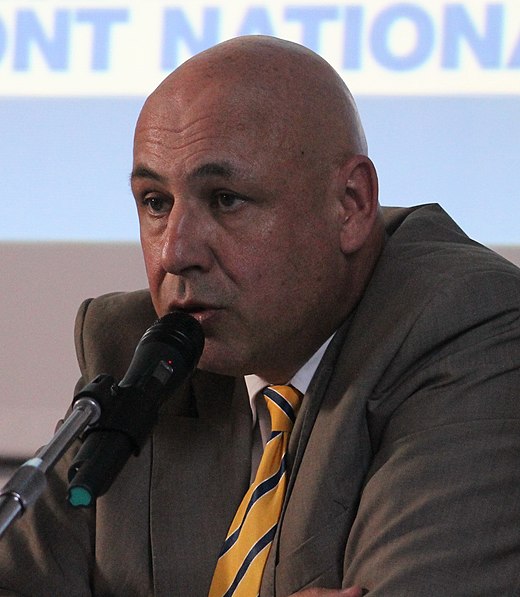
Christian Bouchet is one of the more unconventional figures in contemporary French political and intellectual life: a publisher, writer, and scholar of religious and esoteric currents, whose journey through nationalist-revolutionary and Eurasianist circles has made him a unique voice in Europe’s post-liberal debate. Trained in ethnology, Bouchet has combined academic inquiry with decades of metapolitical activism, founding journals, networks, and the publishing house Ars Magna, through which he has introduced to French audiences authors ranging from Julius Evola to Alexander Dugin and Jean Thiriart and Francis Parker Yockey.
For Bouchet, the central political question of the 21st century is civilizational sovereignty. He argues that the West’s project of universalisation—economic, moral, and cultural—has produced a global homogenization that dissolves authentic identities. In response, he advocates “ethno-differentialism,” a doctrine asserting the right of peoples and cultures to remain themselves rather than being absorbed into a single, liberal-capitalist model of humanity. This perspective places him inside the broader multipolar paradigm, which sees the future belonging to distinct civilizational blocs rather than one hegemonic power.
His interest in geopolitical conflict has taken him beyond theory and into contact with emerging zones of alternative statehood, including a visit to the Donbas, where he sought to understand on the ground how identity, war, and resistance shape new political realities outside Western influence.
In the following conversation, we explore the intellectual foundations of his work, the future of Europe in a multipolar world, and the role of culture, spirituality, and publishing in the struggle for civilizational self-determination.
This interview was conducted by Constantin von Hoffmeister.
You have explored nationalist-revolutionary and metapolitical domains. How would you describe the internal continuity of your intellectual journey from the 1970s to the present day?
I’ve kept a diary since I was 11. Its intellectual consistency has always surprised me. My ideas have remained the same for 60 years. Of course, they’ve become more refined, but they haven’t changed. So, they come from my soul, not from the outside world. I sometimes express myself by referring to someone else’s thoughts, but when I do this, I keep in mind this quote from Sylvain Tesson: “Quotations are not screens behind which to take refuge. They are the formulation of a thought that one once cherished and recognizes, happily expressed, in the writings of another. Quotations reveal the soul of the one who uses them.”
How has your training in ethnology influenced your political worldview, in particular your perception of civilizational differences?
I think the opposite happened. It was because I was aware of these civilizational differences that I became interested in ethnology. Reading Herder greatly influenced me in this regard.
You have been an activist, an academic, and a publisher. Which of these roles has most defined your sense of mission?
Without a doubt, publishing. That’s where I was most useful.
My past as a student and teacher didn’t contribute much to our cause. Activism was something others could do, even though I never aspired to be an activist.
To be a publisher, you need a desire to transmit knowledge that very few have, and that I had.
I don’t mean to sound arrogant, but if I hadn’t directed Ars magna, who would have had Francis Parker Yockey, Ferenc Szalasi, Alexander Dugin, Karl Otto Paetel, Ivan Ilyin, and others translated and published in French? Who would have undertaken the republication of the complete works of Georges Valois? Who would have taken on the task of translating and publishing Scarabelli’s biography of Evola and the most recent Evola miscellany? Who would be planning to publish Rohan, Ustrialov, and Ikki Kita soon?
There are very few “radical right-wing” publishers in France and none of them have, like me, a clear and precise publishing policy, without worrying about making big sales or making their investment profitable.
Through your publishing house, Éditions Ars Magna, you have published texts by authors as diverse as Alexander Dugin, Julius Evola, Guillaume Faye, and Jean Thiriart. In your opinion, what unites these very different authors?
An imperial ambition, the dream of an imperial state stretching from Galway to Vladivostok. That said, there are many differences between them regarding how to achieve it and what it should be.
The Italian communist thinker Antonio Gramsci believed that political power is won long before elections, by shaping culture, language, and how people perceive the world. According to this view, books, ideas, and the media can be more decisive than laws or political parties.
Do you consider publishing a form of political warfare, a metapolitical front in the Gramscian sense?
Absolutely. But I’m talking about mainstream publishing, which is aimed at everyone and has large print runs. I, on the other hand, only work in niche publishing, where the books don’t reach the masses. That doesn’t mean they have no influence, however, but it’s more indirect: they influence activists and political leaders who, in turn, influence the masses.
While multipolarity describes a world shaped by several major centers of power, Eurasianism puts forward a more specific civilizational idea: that Russia, Central Asia, parts of Europe, and sometimes Iran and other neighboring cultures, form a distinct geopolitical and cultural space that is neither Western-Atlantic nor purely Asian. This view considers the heart of the world not to be in Washington or Brussels, but in a vast continental landmass stretching from the Carpathians to the Altai Mountains and from the Arctic to the Persian and Turkic cultural zones. What has been your experience translating and presenting Eurasian thought to French audiences? Has French political culture been receptive or resistant?
For the general public, as well as for intellectuals of the traditional right, the idea is utterly ludicrous. However, it resonated strongly within the Greater European nationalist movement, as it shares many similarities with the theories of Niekisch, Yockey, Faye, and Thiriart—the last one having, for a time, even suggested that Istanbul should become the capital of “Greater Europe”…
What is the main mission of your publishing house Ars Magna today: to archive, to awaken, or to convert?
All three, simultaneously!
In your recent writings, you seem to be asserting a Catholic cultural horizon for Europe. Do you consider Catholicism to be the authentic European tradition or simply one expression among others?
In its form following the ordo antiquor, it is undoubtedly the authentic tradition of Western Europe, at least of a part of it. I discern traces of tradition in certain Anglican currents resistant to the modern world and the evolution of their Church. As for Protestantism, I don’t know. My maternal grandfather was Lutheran, but I know very little about contemporary Protestantism and I don’t know if any fragments of tradition can exist in its forms not contaminated by the modern world.
I believe that each geographical area and each people has its own particular tradition. I am Catholic by tradition because I live in France; if I lived in Russia, I would probably be Old Believer Orthodox, Shiite if I were Iranian, Sufi if I were North African, Shaivite if I were Indian… All of this makes me very hostile to any conversion and any proselytism.
Traditionalist thinkers René Guénon and Julius Evola argued that modernity represents the final stage of a long civilizational degeneration: an eclipse of initiation, sacred kingship, metaphysical knowledge, and the vertical relationship between humanity and the divine. According to them, the West has traded a comprehensive spiritual order for technological power, mass culture, and purely materialistic conceptions of life. From your perspective, what remains of the sacred in the contemporary West?
In the West, only traces of it remain, in popular rites, in monasteries.
How do you interpret the current fascination of young nationalists with pagan revival and magical thinking? Is it a symptom or a solution?
I don’t see any “fascination among young nationalists in France with pagan revival and magical thinking.” There was a brief surge in neo-paganism a few decades ago, but it didn’t reach many people and it didn’t last. It wasn’t truly a religious phenomenon; at best, it was reconstructionism, reenactment as the Anglo-Saxons say, at worst, parody.
If there is a dominant trend among French “right-wing” youth, it is the return to a practice of Catholicism in an identity-based version.
You have promoted the idea that European nationalists and traditional Islamic forces might have deeper enemies in global liberal modernity than they have among themselves. Concretely, what would a Euro-Islamic axis look like, and how could Europe and the Islamic world establish cooperation while fully preserving their distinct spiritual and civilizational identities?
Europe faces a major problem: the influx of migrants. For political and geopolitical reasons, some want us to look the other way and claim that the only problem is a religious one, and that it has a name: Islam. This conveniently implies that non-Muslim immigration is therefore acceptable and that we share the same enemies as a small entity in the Middle East.
Hence, my consistent position is to denounce immigration and not the religion of immigrants.
After that, is a militant approach conceivable? If we are talking about the political field, there has always been an affinity and relations between European nationalist currents and certain major Arab nationalist organizations such as the Ba’ath, or local nationalists such as the Libyan Jamahiriya, the PFLP-GC in Palestine, or the Syrian Social Nationalist Party.
There were shared political visions and a common enemy as well. But the institutional weakness of European nationalist groups prevented this from going very far, and subsequently the Arab nationalist groups collapsed.
If we’re talking about the traditional sphere, it’s logical that a traditionalist would identify with the traditionalist currents of other peoples, such as Sufism or certain forms of Shi’ism within Islam. It’s equally logical that they would consider the enemy to be the modern world, not another tradition. There have been contacts there as well, but again, these have not gone very far.
In conclusion, I don’t believe at all that a Euro-Islamic axis is possible. At best, one could hope that Europe would have an independent Arab and Muslim policy and not be entirely subservient to the interests of the Zionist entity.
Islam and Muslims themselves are not our enemies. Returning to the issue of immigration, immigrants must be sent back, not because they are Muslim, but because they are not “one of us,” regardless of their religion.
How do you define the Eurasian civilizational space in geographical, spiritual, and political terms?
Like the Earth Empire stretching from Galway to Vladivostok, with Moscow, as the Third Rome, as its capital. Like a state structured according to the functional tripartite division of the Indo-Europeans. Like a vast archeofuturistic space.
In your view, what is the most dangerous illusion that underpins Western unipolar domination today?
That Western Europe needs the American “big brother” to ensure its defense and that the Zionist entity has the same enemies as us.
Can you elaborate on your concept of “ethno-differentialism” and explain how it contrasts with both racism and liberal universalism?
There are actually two forms of racism. The one we usually call by that name is a racism of exclusion, domination, and even extermination. The other is universalist racism, whether liberal or not. This is a racism of negation: it denies what makes others different and dreams of a uniform world where cultures and affiliations are no longer transmitted but are simply sets of attributes that one chooses and can change according to the spirit of the times. Everyone is the same, and differences are merely marginal and fleeting. Ethno-differentialism, inspired by Herder, considers all cultures to be inherently respectable and must be preserved. It believes that identity is paramount. It is a rejection of a monochrome world.
Is multipolarity simply a geopolitical reality or does it have a metaphysical significance, that of a restoration of plurality against the Tower of Babel of globalism?
Both, of course. In this regard, we should also reread Herder.
You joined the National Front (now the National Rally) later in your career. How do you assess Marine Le Pen’s attempt to mainstream nationalist politics in France?
Henry IV said, “Paris is well worth a Mass.” Marine Le Pen could say, “Paris is well worth a teshuvah.” The end justifies the means. Marine Le Pen and her followers are involved in “high politics,” which has nothing to do with what we are dealing with.
I am not criticizing her today and I will not criticize her tomorrow, any more than I criticize Trump or Meloni, because we are not playing in the same league.
Has French nationalism lost its revolutionary character since the 1980s?
No, because I think it never had it except on extremely narrow margins. The massive revolutionary character of French nationalism disappeared as early as the First World War. Afterwards, it was only marginal.
Do you think a truly sovereign France could exist again within the current structure of the European Union?
No. But an independent France would be preferable to the France we know within Europe. Europe as a structure needs to be recreated, and I await its Cavour.1
What role do you see for intellectuals in preparing a post-liberal Europe?
That of watchmen and that of awakeners.
What advice would you give to young thinkers seeking to find a balance between tradition, revolution, and realism in a chaotic world?
To pray a lot, to join a traditional structure if they can find one—perhaps a third order or a fraternity—within their reach, to frequently retreat to the desert.
Do you primarily see yourself as a bridge between the political and the spiritual?
I don’t have that ambition. I long dreamed of founding an order or, failing that, a new Group of Ur. I haven’t had the chance to see that dream come true.
Does what you read or study today challenge your own worldview?
No, absolutely not!
After decades of activism, scholarship, and controversy, what do you think is the essential idea worth defending?
Undoubtedly, loyalty to one’s own, to those who came before us, and to those who placed their trust in us. In this regard, there is a quote from Robert Brasillach that I have adopted as my own: “What would the young people who listened to me and followed me think of me if I were to betray my principles?”
You traveled to the Donetsk People’s Republic. What motivated you to make this trip, and what did you observe on the ground in terms of cultural, civilizational, and geopolitical dynamics? How does this experience fit into your broader vision of a multipolar world where different civilizational entities resist Western influence?
I went to the Donetsk People’s Republic because I was invited and recognized as an influential figure who supported it. I saw a people standing tall and upright. I observed an ethnic and cultural homogeneity that the West no longer possesses.
The reorganization of Ukraine, with borders that correspond to something real, should benefit everyone in this region of the world. Novorossiya, of course, but also Romania, Poland, and Hungary.
In his book Archeofuturism, the French New Right philosopher Guillaume Faye argues that the future belongs to societies capable of reconciling mythical identity with advanced technoscience, and that Europe will have to face a catastrophic upheaval before such a synthesis can emerge. As we sink deeper into a systemic crisis—economic, demographic, geopolitical—do you envision an archeofuturistic future for Europe, and what forces or institutions could bring it about?
If Western Europe continues on its current path, its future risks being not at all archaeofuturistic but resolutely third-worldist.
If such a synthesis—tradition and technology, myth and power—does not occur in Europe, who will shape the future in its place?
China, Russia, and probably India.
Source : https://www.multipolarpress.com/p/interview-with-christian-bouchet